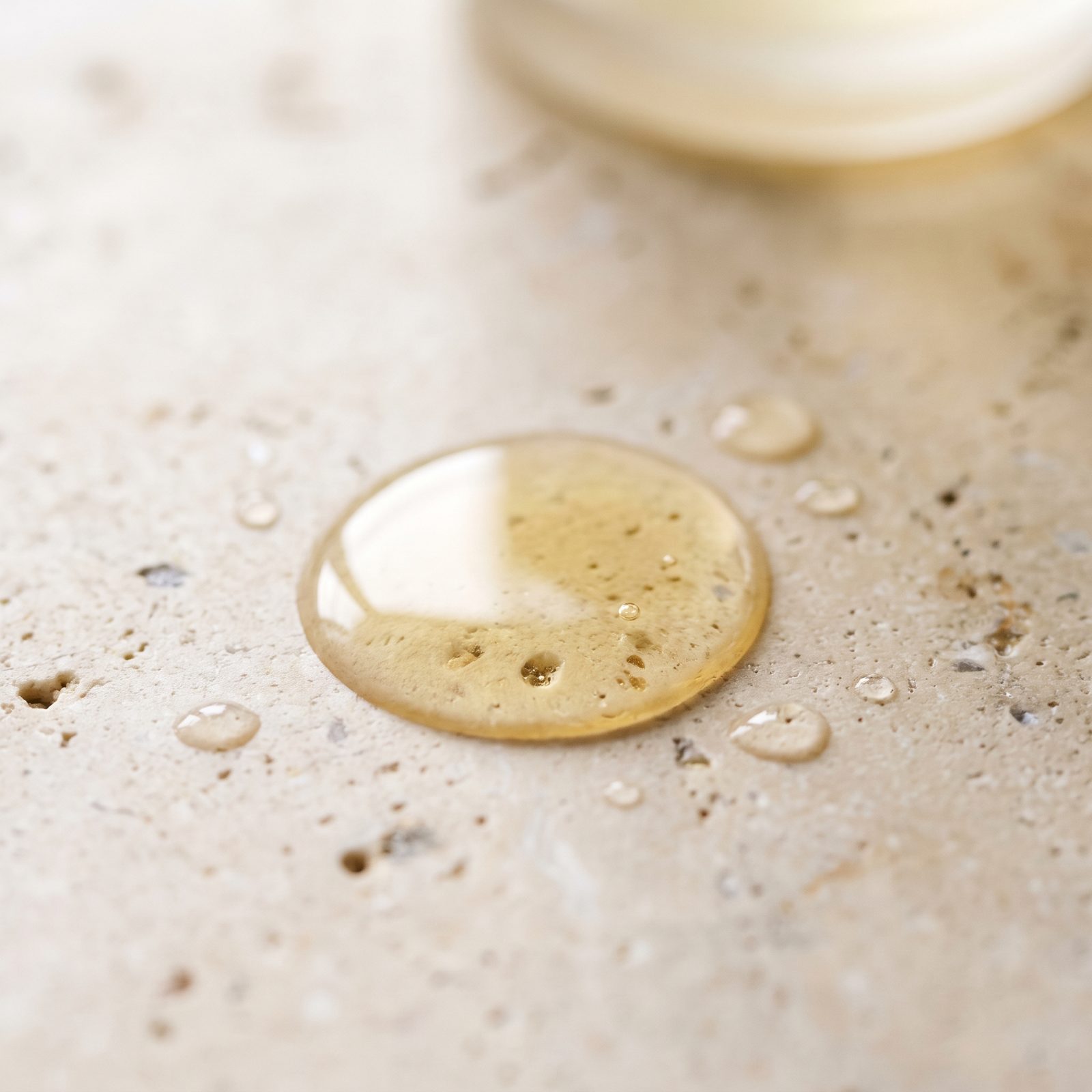
Ozonated olive oil is olive oil that has had medical-grade ozone bubbled through it until the oxygen bonds into the oil’s fatty acids as stable compounds called ozonides. The result is a thicker, paler oil with a distinctive sharp scent, used in skincare as a moisturizing, comforting ingredient for skin that feels dry, tight or over-treated. OzoMD Ozonated Elixir Oil carries ozonated olive oil in squalane, jojoba, sunflower and rosehip, so it behaves like a face oil rather than a paste.
That is the short version. The rest of this guide answers the questions people actually type, and links the research on the ingredient where it exists.
How is ozonated olive oil made?
The process has three parts, and none of them is exotic.
- Start with a clean base oil. Classically, cold-pressed olive oil, because it is rich in oleic acid, a fatty acid with a double bond that ozone can react with.
- Generate ozone from oxygen. An ozone generator passes oxygen through an electrical field, which rearranges some of the O₂ into O₃, ozone. The quality of the oxygen going in matters; OzoMD’s oil is made from a pharmaceutical-grade oxygen source in an NSF-certified facility in the USA.
- Bubble the ozone through the oil. The ozone is diffused through the oil for an extended period, usually while the oil is kept cool. It reacts with the double bonds in the fatty acids and is captured as ozonides. The longer the process runs, the thicker and paler the oil becomes.
Run the process all the way and liquid olive oil turns into a waxy, almost white paste that is solid at room temperature. That is what most ozonated olive oil on the market is. OzoMD carries its ozonated olive oil in a blend of lighter lipids so that it pours, spreads and absorbs like a modern face oil.
Ozonation is not oxidation in the kitchen sense. Olive oil left open on a counter goes rancid. Olive oil ozonated under controlled conditions becomes a different, stable material.
What are ozonides?
An ozonide is the compound formed when ozone adds across a carbon-carbon double bond. In olive oil, those double bonds live in unsaturated fatty acids such as oleic acid. When ozone meets one, it opens the bond and inserts itself, forming a small ring of carbon and oxygen (chemists call it a 1,2,4-trioxolane). Related oxygenated compounds form alongside them, and it is the whole family that gives ozonated oil its character.
Two things about ozonides matter in practice. They are stable: unlike ozone gas, which breaks down in minutes, ozonides can sit in an oil for months, so the oil can be bottled and shipped. And they are active on contact: as the oil warms on skin, they slowly release trace amounts of oxygen, which is where the scent comes from. Our science page walks through the chemistry in more depth, along with what we do and do not claim.
Why does ozonated oil smell like that?
People describe it as sharp, clean, metallic, “like the air after a thunderstorm.” That is the smell of ozonides and the trace oxygen they release. It is the signature of the ingredient, not a flaw, and the fastest way to tell real ozonated oil from a product that merely mentions ozone on the label. If an “ozonated” oil has no scent at all, it probably holds very little ozonide.
How strong the smell is depends on the format. A fully ozonated paste is intense and can linger. OzoMD Ozonated Elixir Oil carries its ozonated olive oil in squalane, jojoba, sunflower and rosehip, so the note is brief: it fades within about a minute and leaves no fragrance behind. Nothing is added to mask it; that would mean adding perfume, which over-treated skin does not need.
Ozonated vs ozonized vs “oxygenated” oil
- Ozonated oil and ozonized oil mean the same thing: oil treated with ozone until it holds ozonides. “Ozonated” is the common American spelling; “ozonized” appears more in older and European literature.
- “Oxygenated” oil is a marketing phrase with no fixed meaning. It can describe genuine ozonated oil, or an ordinary oil that has had air bubbled through it, which does nothing useful. Read the ingredient list and ask about peroxide value.
- “Ozone skincare” and “oxygen skincare” are broader still. Ozonated oil is not an oxygen facial and not a gas you apply. It is a lipid ingredient in a jar.
What does peroxide value mean?
Peroxide value (often written PV) is the standard laboratory measure of how far an oil has been ozonated. It counts the active oxygen held in the oil’s peroxide-type bonds, expressed in milliequivalents of active oxygen per kilogram of oil. For an ordinary cooking oil, a low peroxide value means freshness and a high one means rancidity. For ozonated oil, the scale is read the other way: a higher peroxide value means more ozonides were formed, and so a stronger, thicker oil.
Two practical notes. “Higher” is not automatically “better”: a very high peroxide value also means a heavier texture, a stronger smell, and more potential to feel intense on reactive facial skin. And peroxide value falls slowly over time, faster with heat and light, which is why storage matters.
How is it different from regular olive oil, a paste, or squalane?
The comparison people ask for most, in one table. Prices for the other three vary by brand and size, so we have not invented numbers for them.
| Plain olive oil | Fully ozonated olive oil paste | OzoMD Ozonated Elixir Oil | Squalane | |
|---|---|---|---|---|
| Texture | Fluid, slightly greasy | Thick, waxy; solid or gel-like at room temperature | Light, fluid face oil | Very light, dry-touch |
| Scent | Grassy, olive | Strong, sharp, ozone-like; can linger | Brief clean, metallic note that fades within about a minute; fragrance free | None |
| Absorption | Slow; sits on the surface | Slow; stays on the surface | Absorbs within minutes when pressed into damp skin | Fast |
| Pore-clogging risk | Higher; many find it heavy on the face | Higher; usually kept to hands, heels, elbows | Low; formulated non-comedogenic | Low |
| Shelf life after opening | Varies; degrades with light and heat | Varies; check the maker’s label, often kept cool | Six months for peak freshness, capped and out of direct sun | Varies; stable |
| Best for | Cooking; body in a pinch | Spot use on rough hands, heels and elbows | Face, hands, body and lips; nightly recovery for over-treated skin | Lightweight daily moisture |
| Price per use | Varies | Varies | About 19 cents (2 fl oz, roughly 400 uses) | Varies |
What does ozonated olive oil feel like on skin?
A fully ozonated paste feels like a dense balm: you warm it between your fingers and it sits on the skin as a protective layer that takes its time to sink in. Excellent on heels and knuckles, less pleasant on a face under a pillow.
OzoMD Ozonated Elixir Oil feels like a slightly richer version of a modern face oil. Two or three drops spread easily; pressed into skin that is still slightly damp from cleansing, it absorbs within minutes and leaves a soft, cushioned finish rather than a slick. Skin that felt tight after cleansing feels comfortable, flakes look smoother once moisturized, and the look of redness softens as skin stops feeling parched. None of that is a treatment; it is what good moisture does for the look and feel of the skin barrier.
How to use ozonated olive oil
The method is the same everywhere on the body: clean skin, a small amount, press rather than rub.
- Face: at night, on clean, slightly damp skin, warm two or three drops between your fingertips and press them over the face and neck. On nights you use retinol or acids, skip the oil and use it on your rest nights instead; our guide to ozonated oil and retinol explains the timing. Seal with OzoMD Ozonated Face Cream if you like.
- Hands: two or three drops after washing, worked into knuckles and cuticles.
- Body: a few drops on elbows, knees, shins and heels while skin is still damp from the shower.
- Lips: a single drop pressed in.
Start with every other night if your skin is very reactive, and build to nightly. Full directions and the honest limits are on the ozonated olive oil elixir page.
One jar. Face, hands, body, lips.
OzoMD Ozonated Elixir Oil: ozonated olive oil carried in squalane, jojoba, sunflower and rosehip. Physician formulated, fragrance free, non-comedogenic, made in the USA. 2 fl oz, about 400 uses. See the oil or pair it with the cream.
Start Your ResetWho should skip ozonated olive oil?
It is a cosmetic for intact skin, and it is not for everyone.
- Broken skin. Keep it off anything open, cracked or raw; that needs a clinician, not a jar.
- Known olive allergy. The active lipid is olive oil. If you react to olives or olive oil, choose something else.
- Babies and small children. Ask your pediatrician before using anything new on their skin, including this.
- Anyone under a dermatologist’s care. Ask before adding a new product.
Everyone, at any age, should patch test first: a drop on the inner arm, left for a day. Ozonated olive oil is not a treatment for any skin condition.
What the research says about ozonated olive oil
Ozonated olive oil has been studied topically for decades, mostly in small clinical and laboratory settings. Two references are a good starting point.
- Safety review, 2022. A systematic review of nine studies of topical ozonated oil found no significant dermatologic risk in short-term use, with the usual caveat that the samples were small. 2022 systematic safety review · PubMed
- Chemistry and background review, 2010. Travagli and colleagues reviewed how ozonated vegetable oils are produced, how ozonides and related compounds form, why peroxide value is used as the quality measure, and how the oils have been investigated as a topical ingredient. Travagli et al., 2010 · PubMed
OzoMD is a cosmetic; this is research on the ingredient, not a claim about the product. We make no medical claim for the oil. What we claim is narrower: it moisturizes, it comforts skin that feels tight, and it supports the look and feel of a skin barrier that has been through too much.
Frequently asked questions
How is ozonated olive oil different from regular olive oil?
Regular olive oil is a cooking fat that sits on the skin. Ozonated olive oil has had ozone bubbled through it until the oxygen bonds into its fatty acids as ozonides, which makes it thicker, paler, sharper smelling and, in skincare, a different ingredient. You cannot make it at home by leaving olive oil in the air.
Why does ozonated oil smell so strong?
The sharp, clean, metallic note is the signature of ozonides and the trace active oxygen they release as the oil warms on skin. A fully ozonated paste smells strongest. OzoMD Ozonated Elixir Oil carries ozonated olive oil in squalane, jojoba, sunflower and rosehip, so the note is brief and fades within about a minute. No scent at all usually means little ozonide content.
Does ozonated olive oil need to be refrigerated?
Fully ozonated pastes are often kept cool to slow the ozonides breaking down; check the maker’s label. Keep OzoMD Ozonated Elixir Oil capped, cool and out of direct sun, and use it within six months of opening for peak freshness. Heat, light and an open cap are what age it.
How long does ozonated olive oil last?
Unopened, a well-made ozonated oil keeps for a long time because ozonides are stable compounds. Once opened, use OzoMD Ozonated Elixir Oil within six months for peak freshness. At two or three drops per use, a 2 fl oz jar is roughly 400 uses, so most people finish it well inside that window.
Can you use ozonated olive oil on your face?
Yes, on intact skin. A fully ozonated paste is heavy, and many people keep it for hands and heels. OzoMD Ozonated Elixir Oil is formulated as a face oil: fragrance free and non-comedogenic, two or three drops pressed into clean, slightly damp skin at night. Patch test first, as with anything new. For the full routine, read ozonated olive oil benefits and uses.
Is ozonated oil safe for sensitive skin?
OzoMD Ozonated Elixir Oil is a fragrance-free cosmetic for skin that feels tight, dry or over-treated. A 2022 systematic review of topical ozonated oil reported no significant dermatologic risk in short-term use; that is research on the ingredient, not a claim about the product. Patch test on the inner arm first and use it on intact skin only.
Can you drink ozonated olive oil?
No. OzoMD Ozonated Elixir Oil is a topical cosmetic for external use on intact skin. Do not swallow it, and keep it out of reach of children.
Why is OzoMD more expensive than other ozonated oils?
Because it is not a plain ozonated olive paste. It is a physician-formulated elixir: ozonated olive oil carried in squalane, jojoba, sunflower and rosehip, made in the USA in an NSF-certified facility from a pharmaceutical-grade oxygen source. At two or three drops per use, the 2 fl oz jar at $77.77 is roughly 400 uses, about 19 cents each.